
Stepping into a UK lecture hall for the first time is an exhilarating milestone. The United Kingdom remains a global powerhouse for higher education, drawing talent from every corner of the globe. However, for many international students, the excitement is often met with a sudden realization: the academic expectations here are distinct. It isn’t just about working hard; it’s about understanding a specific scholarly culture that values critical analysis over rote memorization.
Navigating this transition requires more than just a good grasp of the English language. It involves mastering the art of the UK-style essay and understanding the nuances of local grading criteria. Many students find that the intensity of the curriculum, especially in competitive hubs, can be overwhelming. During these high-pressure periods, seeking out specialized assignment help London can provide the structural clarity needed to align your work with the rigorous expectations of British professors. By observing how experts structure arguments and cite sources, you can more quickly adapt to the local “academic DNA.”
The Pillars of the UK Academic Framework
To succeed, you must first understand what UK tutors are looking for. Unlike some systems that reward the correct repetition of facts, the British system is built on Critical Evaluation.
1. Moving Beyond Description
One of the most common pieces of feedback international students receive is that their work is “too descriptive.” In the UK, a “First Class” or “2:1” grade is rarely given for simply stating what happened or what an author said. Instead, you must ask: Why does this matter? What are the limitations of this theory? How does it compare to other perspectives?
2. The Power of Independent Thought
While you must base your work on existing research, your tutors want to see your “voice.” This doesn’t mean giving an unsubstantiated opinion. It means synthesizing different sources to reach your own logical conclusion.
Essential Comparison: UK vs. Global Academic Styles
Understanding these differences is the first step toward high marks.
| Feature | UK Academic Standard | Common Global Alternative |
| Primary Goal | Critical analysis and argument | Content mastery and memorization |
| Voice | Objective, third-person (usually) | Can be more personal or flowery |
| Referencing | Strict (Harvard, OSCOLA, APA) | Variable or less emphasized |
| Feedback | Direct, focus on improvement | Encouraging, focus on effort |
Research Depth and Information Gain
In 2026, Google and academic institutions alike are looking for “Information Gain”—the idea that you are adding something new to the conversation rather than just echoing what is already online. This is particularly vital when you move into the latter half of your degree.
When the time comes to produce a dissertation or a major thesis, the complexity of data synthesis becomes the ultimate hurdle. Using such resources as a scholarly guide allows you to see how professional researchers bridge the gap between raw data and academic insight, ensuring your final submission meets the “gold standard” of UK research.
Mastering the Technicalities: Referencing and Structure
A brilliant argument can be undermined by poor formatting. In the UK, academic integrity is paramount.
The Art of the Bibliography
Whether your university uses Harvard, APA, or Vancouver style, consistency is key. Every claim you make must be backed by a citation. This isn’t just to avoid plagiarism; it’s to show that you have engaged with the wider academic community.
Structural Flow
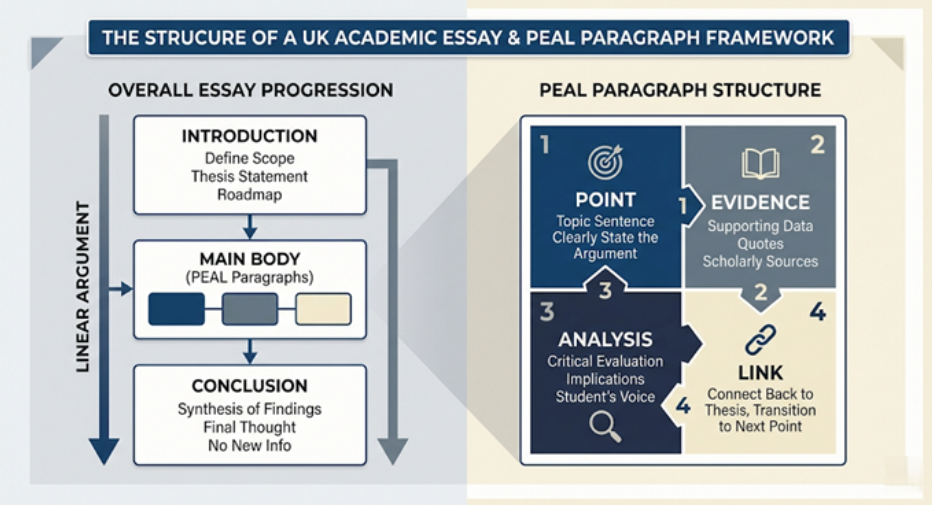
A typical UK assignment follows a very specific “linear” path:
- Introduction: Define the scope and state your thesis clearly.
- Main Body: Each paragraph should focus on a single point (The PEAL method: Point, Evidence, Analysis, Link).
- Conclusion: Summarize your findings without introducing new information.
Tips for Everyday Academic Success
- Read the Handbook: Every module has a handbook that explicitly lists the grading criteria. Read it twice.
- Engage in Seminars: In the UK, seminars are where the real learning happens. Don’t be afraid to disagree with your peers—as long as you have evidence.
- Use University Resources: Most UK unis have “Writing Centers.” Use them early in the semester, not the night before a deadline.
- Manage Your Time: UK degrees often have fewer “contact hours” but expect significantly more independent study time.
Final Thoughts
Adapting to UK academic standards is a marathon, not a sprint. It’s okay to feel a bit lost in the first term. The key is to remain proactive, seek help when the workload feels unmanageable, and constantly refine your ability to think critically. By focusing on quality research and clear structure, you’ll not only pass your courses but truly excel in one of the world’s most respected education systems.
Frequently Asked Questions (FAQ)
Q1: What is the most important part of a UK assignment?
Ans: The most critical element is the Critical Analysis. Tutors want to see that you can weigh different arguments against each other rather than just accepting one as “truth.”
Q2: How do I avoid “descriptive” writing?
Ans: Instead of just saying “X happened,” explain why it happened and what the consequences were. Use “critical verbs” like illustrates, challenges, contradicts, or validates.
Q3: Is it okay to use professional academic support?
Ans: Yes, many students use professional resources as a learning tool. Seeing a high-quality model of an assignment can help you understand how to apply complex UK formatting and argumentative structures to your own future work.
Q4: What is the PEAL method?
Ans: It stands for Point, Evidence, Analysis, and Link. It is a structural framework used to ensure every paragraph stays focused and contributes directly to your overall thesis.
Q5: How many sources should I use?
Ans: As a general rule for undergraduate work, aim for at least 2–3 high-quality, peer-reviewed sources per 500 words, though this varies by subject.
About The Author
Hello! I am Lucy Wilson, and I am proud to serve as a Senior Academic Consultant at Myassignmenthelp. With years of experience specializing in the UK education sector, I focus on helping international students navigate the complexities of British academic standards.